




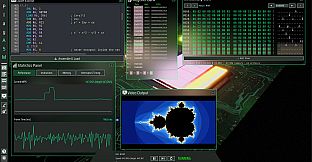
PlayASM is an indie casual simulation game built around a complete CPU simulator where players write and execute real assembly code on a virtual processor. The experience centers on understanding low-level computer operations through direct interaction rather than abstract lessons or simplified tools.
Gameplay
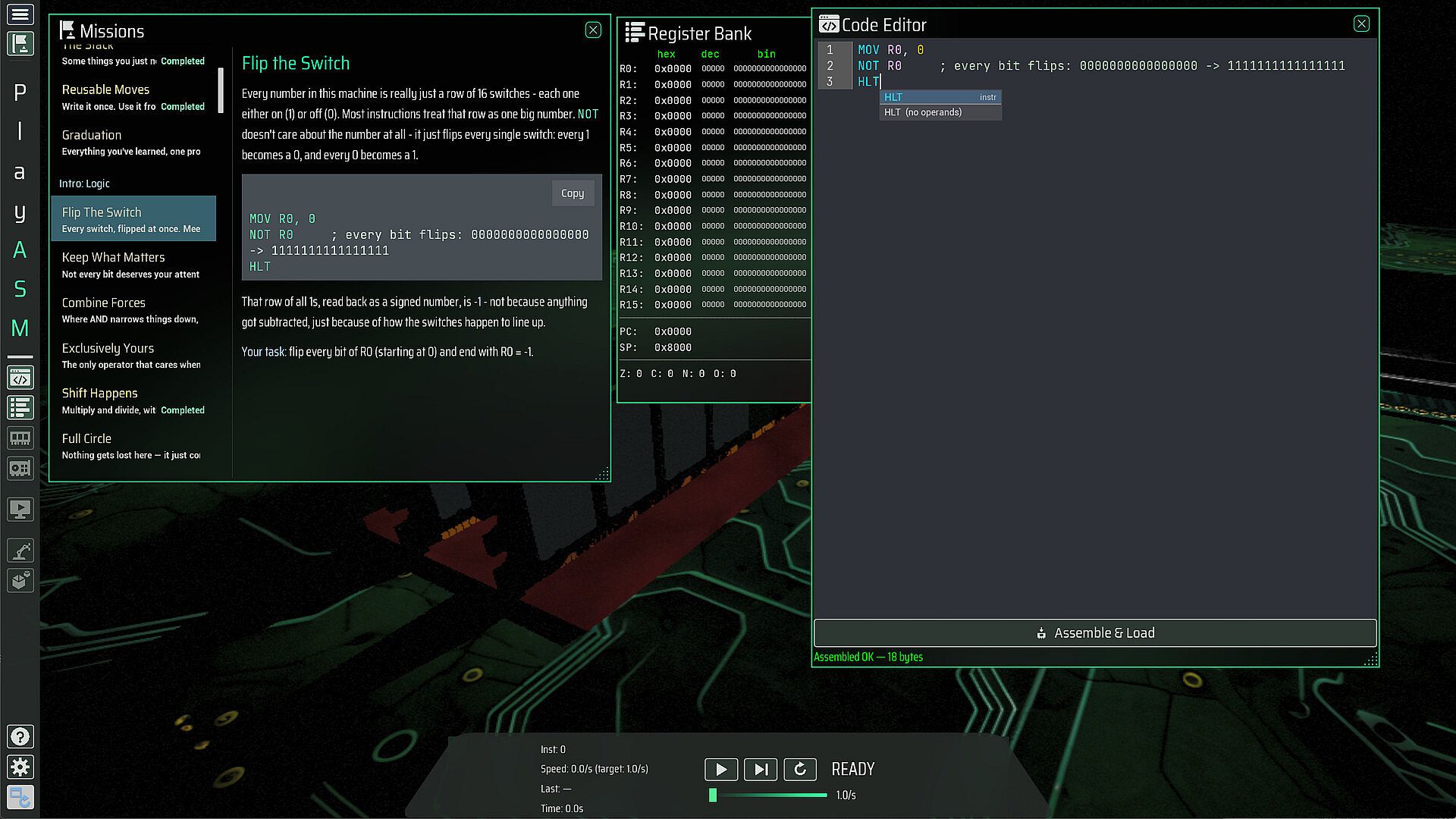
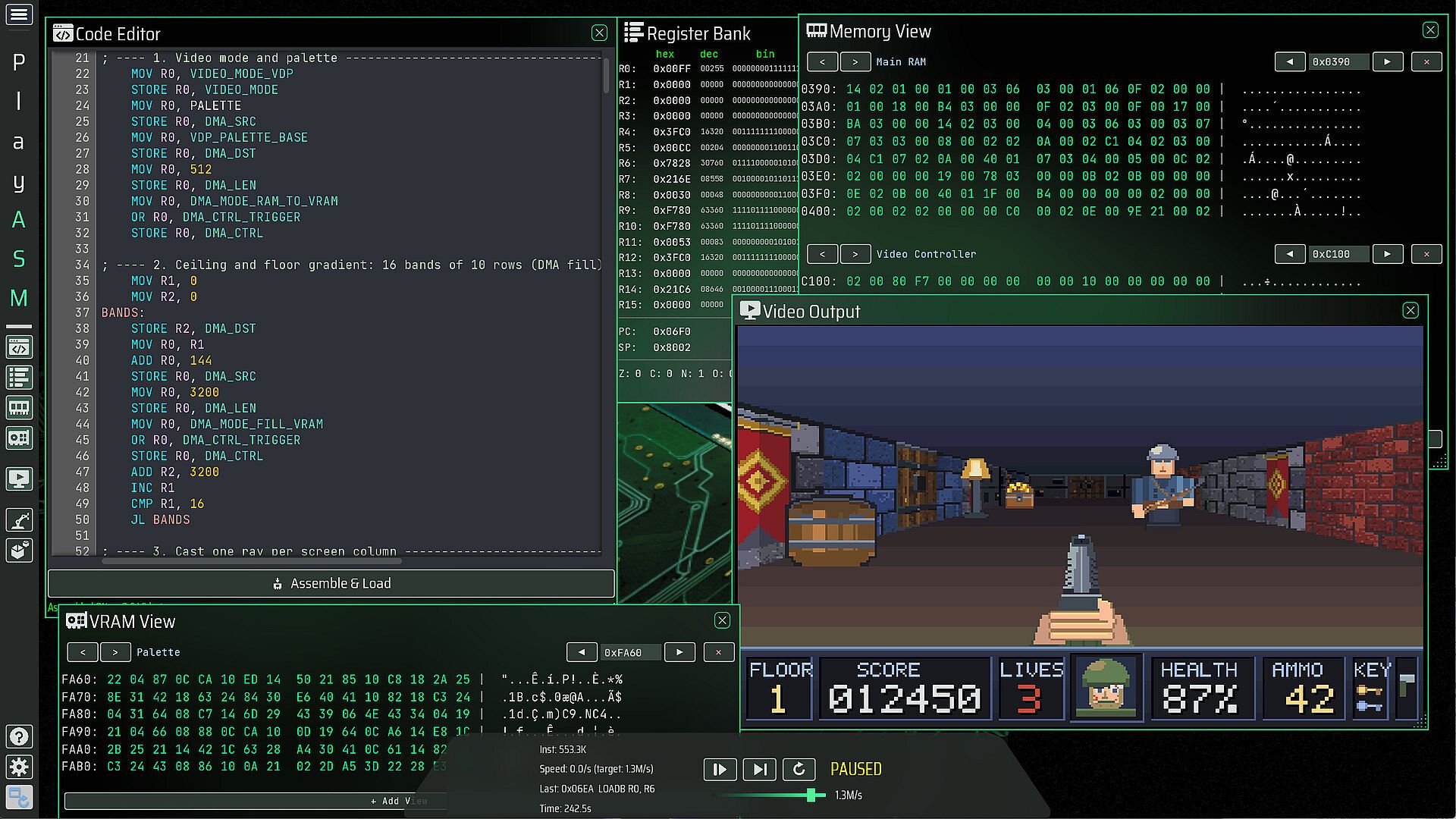
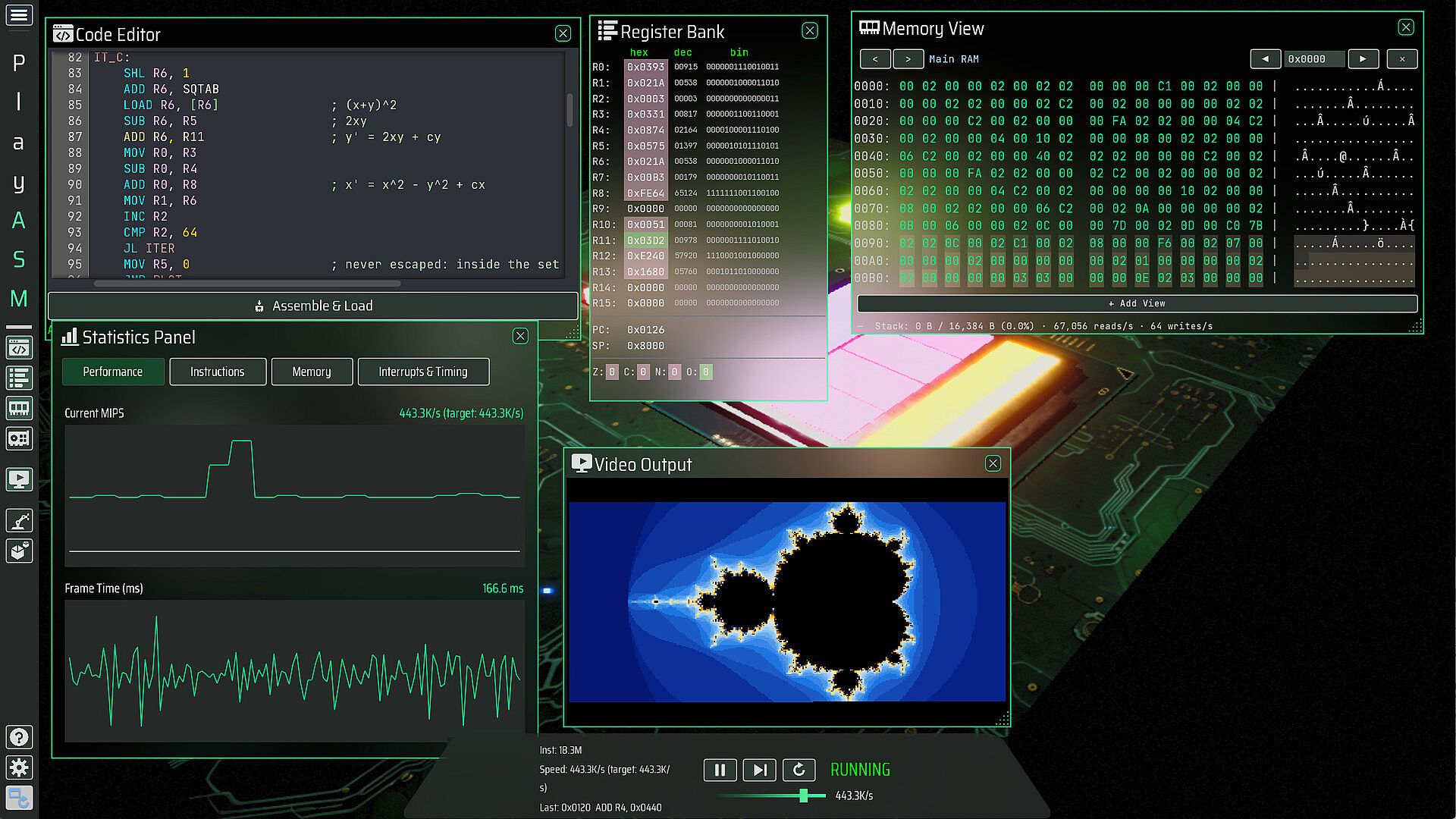
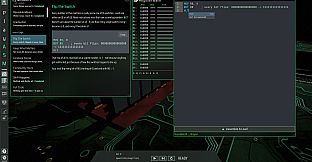
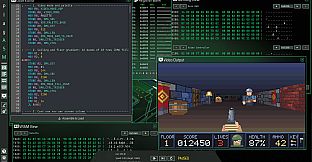
Players begin with basic instructions and progress through hands-on tasks that reveal how a machine reads numbers, interprets their meaning, and acts on them. Every step occurs visibly in a code editor equipped with syntax highlighting, autocomplete, and breakpoints. A register bank and memory view update live in hexadecimal, decimal, and binary formats while execution speed adjusts from single-instruction stepping to full speed. Statistics track performance, instructions, memory usage, and interrupts throughout.
The simulated processor uses a compact instruction set with sixteen registers, a 64 KB address space, and flags that control all decisions. No elements remain hidden or automated, allowing full observation of each processor action. Once core concepts are mastered, additional simulated hardware becomes available through memory mapping, expanding possibilities for custom programs.
Game Modes
The primary structure relies on a mission system that guides players from initial instructions to complex problem solving. Seventy guided tutorial missions introduce bits, bytes, hexadecimal notation, logic operations, shifts, loops, jumps, and the stack. More than one hundred additional challenges range from straightforward exercises to demanding problems that require building reusable subroutines.
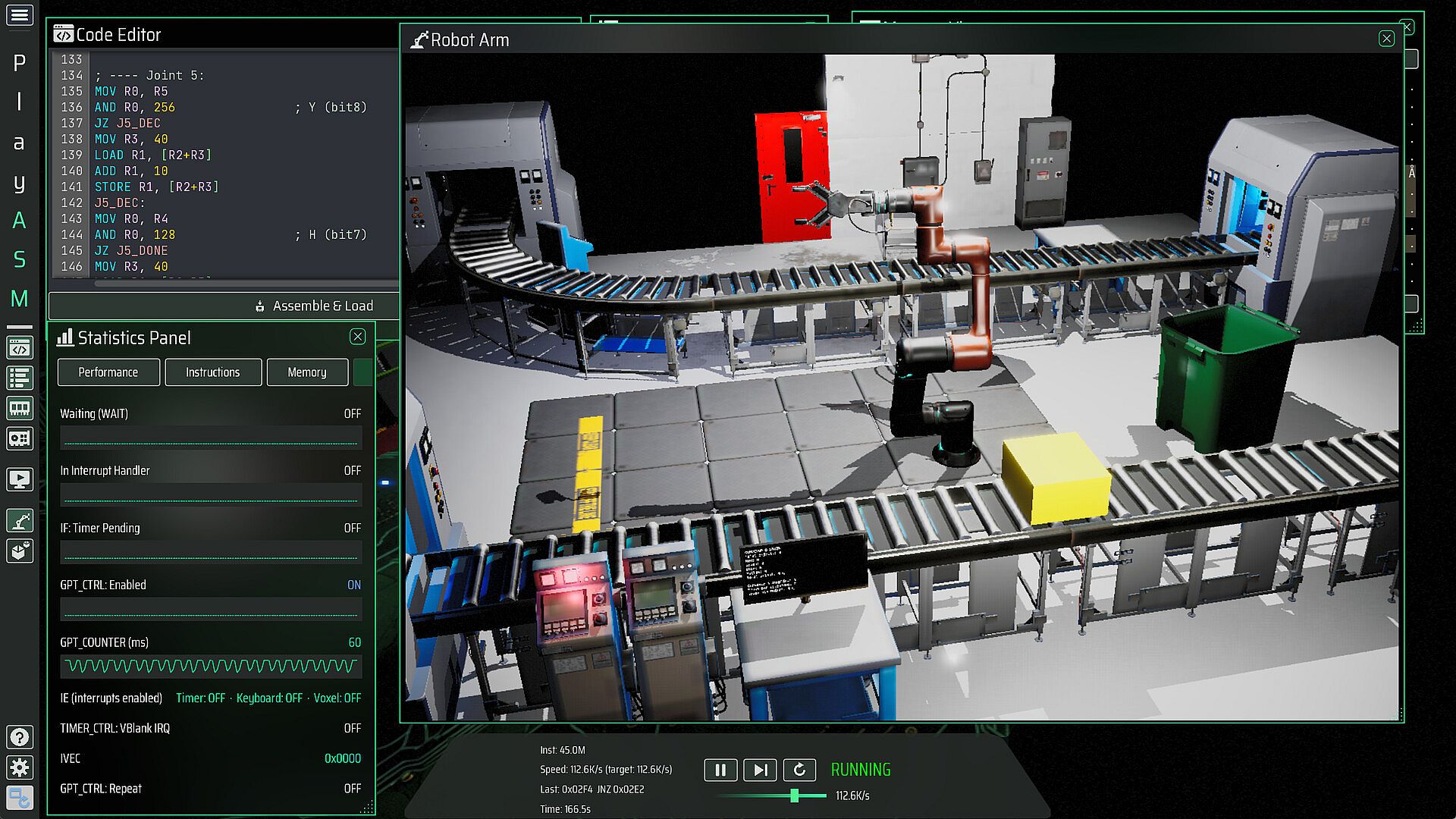
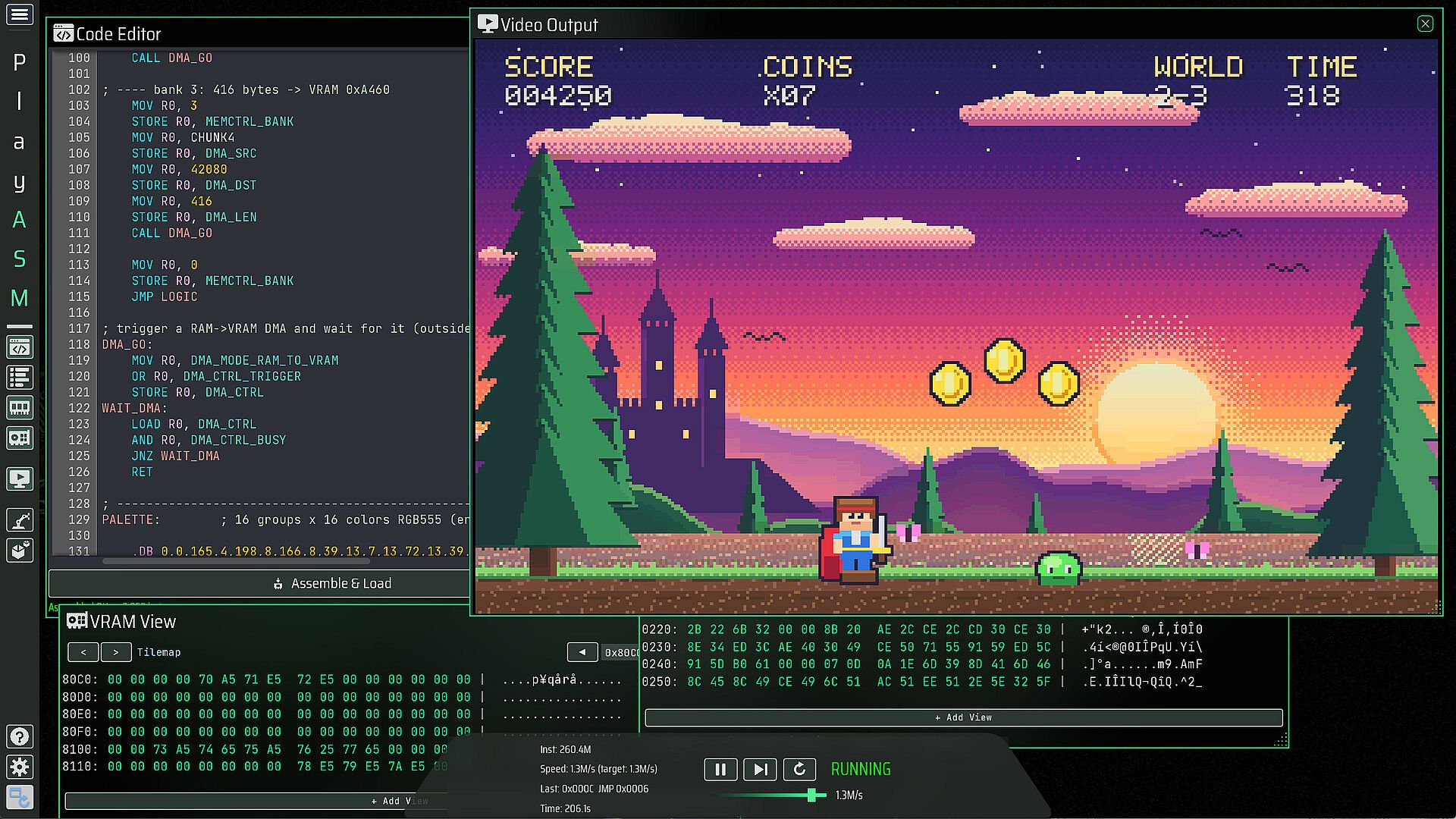
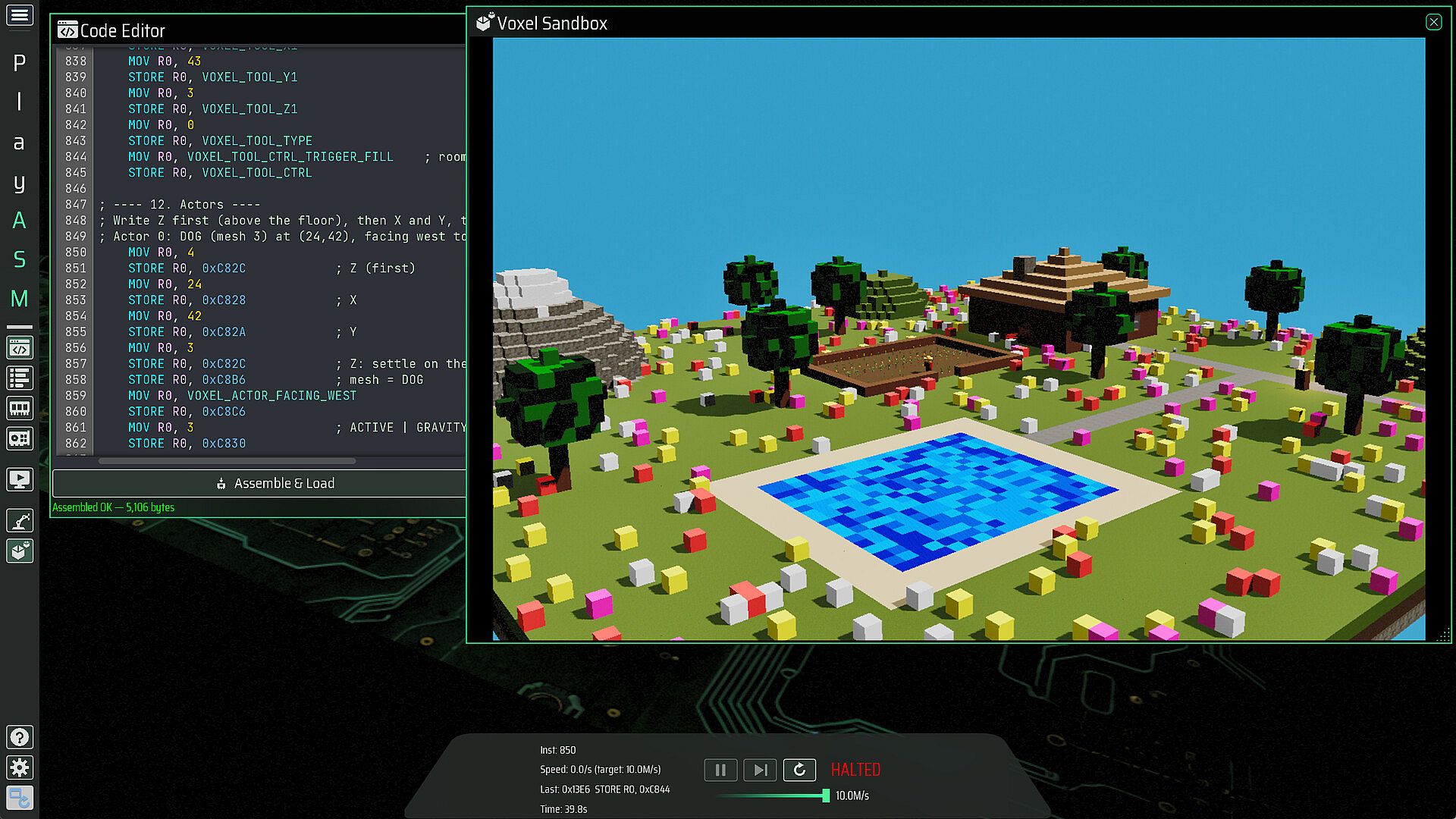
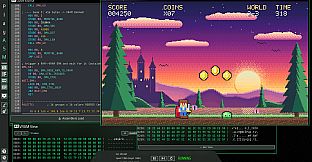
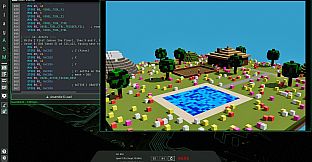
Beyond structured missions, the game supports open-ended creation. Players command three video modes including text, tiles, sprites with scrolling and parallax effects, plus a raw 320 by 200 framebuffer styled after VGA Mode 13h. An eight-channel chiptune synthesizer offers ADSR envelopes, stereo panning, portamento, PWM, and a song sequencer. A six-joint robot arm with gripper and sensors operates alongside a conveyor belt. A voxel sandbox provides three-dimensional creation tools, actors, logic circuits, sand and water physics, and growable crops. Keyboard input, timers, interrupts, DMA, and memory banking complete the hardware set.
Hardware and Creative Tools
Simulated peripherals connect directly to memory addresses, giving players full command over graphics, audio, and mechanical systems. Programs can draw fractals pixel by pixel, compose soundtracks, implement text adventures or platformers, control the robot arm to sort objects, or connect levers to doors in voxel environments. All components operate under the same rules as real hardware, scaled to remain fully comprehensible.
Mod support allows extension through custom devices. Each mod consists of a folder containing a JSON layout and Lua script that adds its own window and memory slice. Changes apply without compilation or restarts, and the Steam Workshop facilitates sharing and installation of community creations.
Target Audience and Accessibility
The game suits curious individuals seeking insight into computer fundamentals, students or self-taught programmers aiming for deeper machine-level understanding, enthusiasts of programming puzzles, and fans of retro computing or chiptune music. No prior experience is required, though later challenges reward existing coding knowledge with additional depth. Support for twelve languages broadens access.
Is It Worth Playing?
PlayASM delivers a precise, transparent simulation of processor behavior paired with practical building opportunities across graphics, audio, robotics, and voxel worlds. The mission progression builds skills methodically while the hardware suite and mod system encourage experimentation. Individuals interested in assembly programming, computer architecture, or creative low-level projects will find substantial value in the hands-on approach and visible mechanics. Those seeking conventional entertainment or multiplayer features may find the focus narrower, yet the depth rewards dedicated exploration of how machines operate at their core.












