




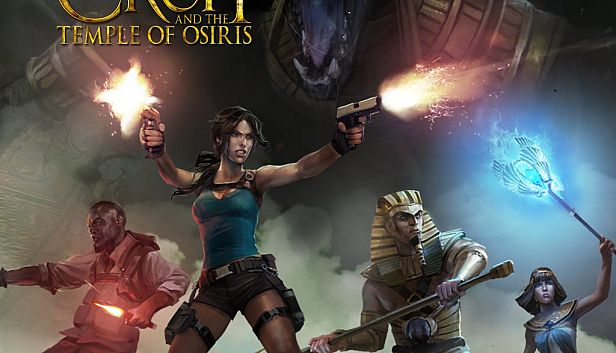




Lara Croft and the Temple of Osiris is an action-adventure game that combines twin-stick shooter combat with environmental puzzles and tomb exploration from a fixed isometric perspective. Released for the PlayStation 4, it continues the spin-off series that began with Lara Croft and the Guardian of Light by expanding the cooperative focus while retaining the core loop of shooting enemies, navigating traps, and solving mechanisms in ancient Egyptian settings.
Gameplay
Players control one of four characters using the left analog stick to move and the right stick to aim weapons, with the right trigger handling continuous fire. Lara Croft relies on dual pistols that never run out of ammunition along with a grappling hook for crossing gaps and assisting teammates. The gods Isis and Horus wield magical staffs that generate protective energy shields and interact with special switches or platforms. Carter Bell shares some adventurer tools with Lara. Combat involves hordes of skeletal foes and scarabs, supplemented by remote-detonated bombs for clearing groups or activating devices. Puzzles require coordination such as one player holding a rope while others cross or using shields as stepping stones, and the game scales these challenges based on the number of participants present. An overworld hub connects the individual tombs and allows restocking before heading into the next area.
Game Modes
The full campaign supports both solo play and cooperative sessions for up to four participants. Single-player adjusts the environment so Lara gains access to the staff abilities needed to progress independently. Multiplayer permits local split-screen or online connections with seamless drop-in and drop-out support. In groups the experience mixes cooperation on shared obstacles with light competition as players race for higher scores, better treasures, and superior artifacts at the end of each tomb. The design encourages replaying sections to optimize performance and collect additional items.
Exploration and Challenges
Progression centers on a series of tombs filled with lethal traps, moving platforms, and hidden collectibles. Red skulls scattered throughout levels contribute to completion rewards, while timed challenges and specific objectives such as freeing skeletons or destroying traps offer further incentives. Each area features multiple scoring tiers that unlock new equipment and upgrades when met. The structure rewards thorough exploration without forcing linear paths, and the isometric view keeps the action visible even during chaotic group encounters.
Is It Worth Playing?
This title suits players who enjoy short, focused sessions of cooperative puzzle-solving mixed with straightforward shooting. The co-op shines brightest when friends join for simultaneous local or online play, turning routine obstacles into lively shared tasks. Solo runs remain fully viable thanks to the adaptive design, though the experience loses some of its chaotic energy without additional participants. The campaign concludes in a handful of hours yet includes enough collectibles and challenge variants to support multiple visits. On PlayStation 4 the game utilizes DualShock 4 vibration feedback and supports standard high-definition resolutions. Those seeking a lightweight action-adventure with strong emphasis on teamwork and clever environmental interactions will find it a solid match, particularly if the isometric twin-stick format appeals.
