



Cutpoint is a tactical strategy game focused on network control, territorial expansion, and physical resource management. Players compete on procedurally generated battlefields consisting of 180 connected nodes, where success depends on maintaining connections to a central base while disrupting opponent supply lines. The experience blends action, strategy, and simulation elements in a free-to-play indie title available on PC, emphasizing local multiplayer and AI opponents over traditional online matchmaking.
Gameplay
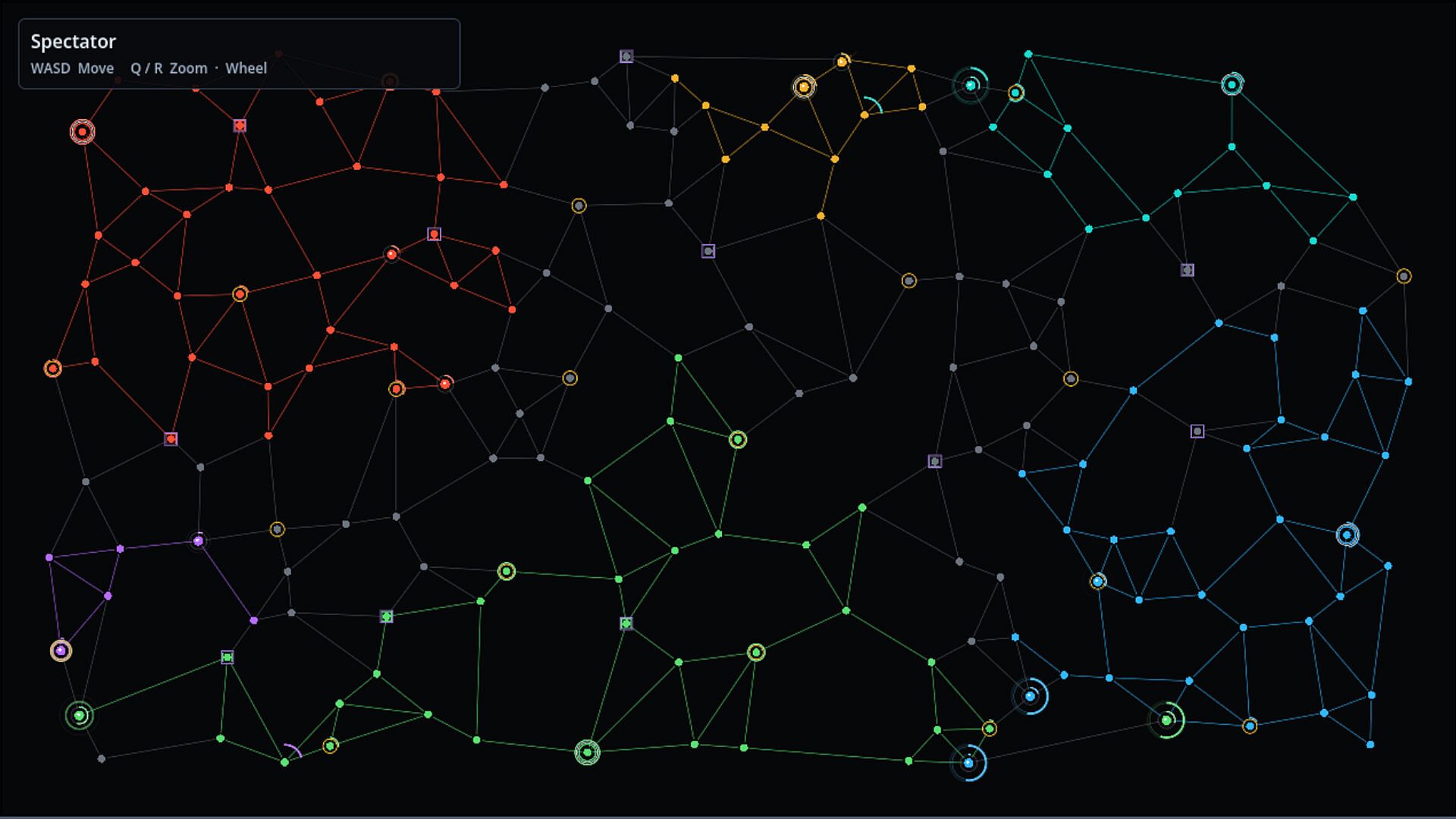
The core loop revolves around expanding territory from a starting base while managing energy as a physical resource rather than an abstract pool. Bases and captured generator nodes produce energy locally, requiring players to travel, collect, and transport it through their network to reinforce nodes, claim neutral areas, or attack enemy positions. Territory remains under control only while connected back to the base, so severing a key link can cause entire branches to collapse and revert to neutral status.
Combat occurs through node captures and infrastructure attacks rather than direct unit battles. Reinforcing nodes strengthens defenses, but the real advantage comes from identifying bridge nodes or vulnerable connections that support large enemy sections. A single well-timed capture can strand opponents, destroy supply routes, or open direct paths to their base. Energy drops from defeated players remain on the field for recovery by either side, adding risk and reward to engagements.
Defense requires more than frontline strength. Strong networks feature redundant routes and protected junctions, while fragile ones risk losing half the map when a critical connection breaks. The base serves as the heart of operations, providing production and respawn points; its destruction ends a player's involvement in the match.
Game Modes
Matches are configured through a flexible local lobby that supports human players, AI opponents, teams, or mixed groups. Options include one-on-one duels, cooperative play against AI, asymmetric team battles, or full free-for-all scenarios where every participant operates independently. Local human players use split-screen views and independently assigned controllers, with support for one keyboard player alongside controllers.
Solo modes pit players against AI that follows identical rules for movement, energy collection, territory management, and reinforcement. AI opponents scout visible areas, remember discovered generators, evaluate network weaknesses, and coordinate with teammates when applicable, operating under the same information limits as humans. Dedicated spectator mode allows observation of AI-only matches without direct participation.
Procedural Networks and Strategy
Every match creates a fresh 180-node network with unique routes, chokepoints, generators, and vulnerable branches. This forces players to analyze the battlefield topology each time instead of relying on memorized layouts. The same core rules support varied outcomes, from gradual territorial pressure to rapid supply races or sudden chain-reaction collapses when critical links are severed.
Strategic depth emerges from balancing expansion distance against supply line length. Pushing too far without redundant connections invites disaster, while conservative play can leave opportunities for opponents to exploit isolated branches. Persistent node reinforcement and capturable generators encourage long-term planning within each match.
Is It Worth Playing?
Cutpoint suits players who enjoy topology-driven strategy, local multiplayer sessions, and games where positioning and connection management outweigh raw reflexes. The emphasis on physical energy logistics and network fragility creates tense decisions that reward observation and timing. Local split-screen support and robust AI options make it accessible for solo play or couch sessions with friends, while the procedural generation ensures high replayability across different network shapes. Those seeking fast-paced territorial control with meaningful defensive layers will find the mechanics rewarding, particularly in matches that highlight clever cuts over brute force. The free-to-play model and flexible configurations lower barriers for trying the distinct approach to strategy gameplay.